

Back to homepage
Click here to access all the video-interviews with seven Uruguayan investigative journalists:
- Fabian Werner
- Gabriel Monteagudo
- Guillermo Garat
- Marcelo Pereira
- Pablo Alfano
- Roger Rodriguez
- Sergio Israel
- Walter Pernas
Why do we share all the interviews?
Because this project aims to open a discussion about the opportunities and challenges of a more diverse and horizontal coverage of transnational and international news.
We hope the interviews start conversations in newsrooms and journalism schools.
The journey to Uruguay
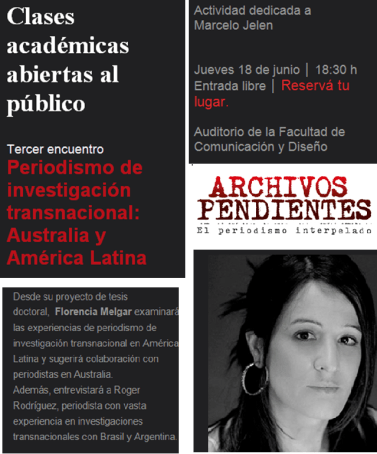
In 2015 Florencia Melgar traveled from Australia to Uruguay to give a talk to journalism students and general public at ORT University about Transnational Investigative Journalism.
The talk explored what kind of potential transnational stories are not being explored and what gaps need to be filled for this to happen. One of issues is how journalists agree on the ways to work together across borders: from diverse editorial views, to different audiences and relevant angles, to the conceptual framework and how to build the trust across borders, as well as how to keep data and sources safe when exchanging information digitally. These are just some of the challenges that a methodological agreement aimed to tackle.
In this initial stage of her investigation, Florencia Melgar decided to do a series of eight exploratory interviews with investigative journalists from Uruguay.
There are two main reasons why she chose Uruguay: firstly because in 2014, when she was invited by Colpin to present one of her investigations in the annual congress of Latin America investigative journalism -celebrated in Mexico in 2014- Florencia identified a fertile field in Latin America to discuss the “how” and the “why” we do investigative journalism.
Surprised by the in depth analysis around the methods used to arrive to the conclusions of the investigations they were presenting, Florencia found Latin America was having a robust conversation about investigative journalism that was not happening in Australia.
The second reason is that she is Uruguayan and worked there as an investigative reporter so she knows who is who and she was able to make an informed decision to choose a sample of experienced journalists who represented three different generations of investigative journalists with diverse views and approaches to journalism.
In these exploratory interviews Florencia aimed to identify:
- their views about a methodology/model/protocol in transnational investigations
- the main challenges faced by investigative journalism in the region
- their views about editorial agreements beyond the practicalities on collaborative work.
Subtitling: The subtitling was done by the author of the interviews and doesn’t meet the translation standards of NAATI accredited translators.
Transcripts: The transcripts of the interviews in Spanish and English can be found here.
Transnational investigative journalism:
a Latin American reflection
(Mexico 2014, Montevideo and Peru 2015)
In this talk Florencia Melgar presented the topic of the doctoral reasearch at RMIT University (Melbourne, Australia), and explored the potential of cross border investigations.
Melgar briefly examined some experiences of transnational investigative journalism in Latin America.
Click on the map to access the Prezi presentation.

She also suggested areas of collaboration between journalists from Latin America and Australia.
18 June, 2015, ORT University, Montevideo, Uruguay. (in Spanish)
As part of this public presentation, Melgar interviewed Roger Rodriguez, one of Uruguay’s most respected investigative journalists.
TIJ in Latin America

It is surprising Latin American in depth reports rarely transcend the region, which is usually under reported or stereotyped by mainstream international media. However, the quality, in-depth and social impact of the investigations is outstanding.
A recent study shows the importance of investigative journalism in Latin America. In 10 years, seven presidents – or former presidents – in the region were prosecuted and/or imprisoned as a consequence of journalists’ investigations (Uceda, 2013).
Latin America’s potential for cross border investigative journalism based on a collaboration model has been identified by Ipys (Press and Society Institute), the Peru-based organisation responsible for the annual Conference of Latin American Investigative Journalists, an event created in 2009 that also recognises the best reporting in the region. http://gijn.org/2015/11/25/colpin-showcases-latin-americas-best-muckraking/
As a response, a new conglomerate, called Connectas, has taken the Latin American cross border collaboration even further in the last three years. As a non for profit organisation, Connectas (http://connectas.org/) is a journalistic initiative that brings together more than 140 journalists from 15 Latin American countries. It promotes the production, exchange, training and dissemination of information in the Americas, privileging a transnational perspective.
 Discussing investigative journalism across borders and cultural practices